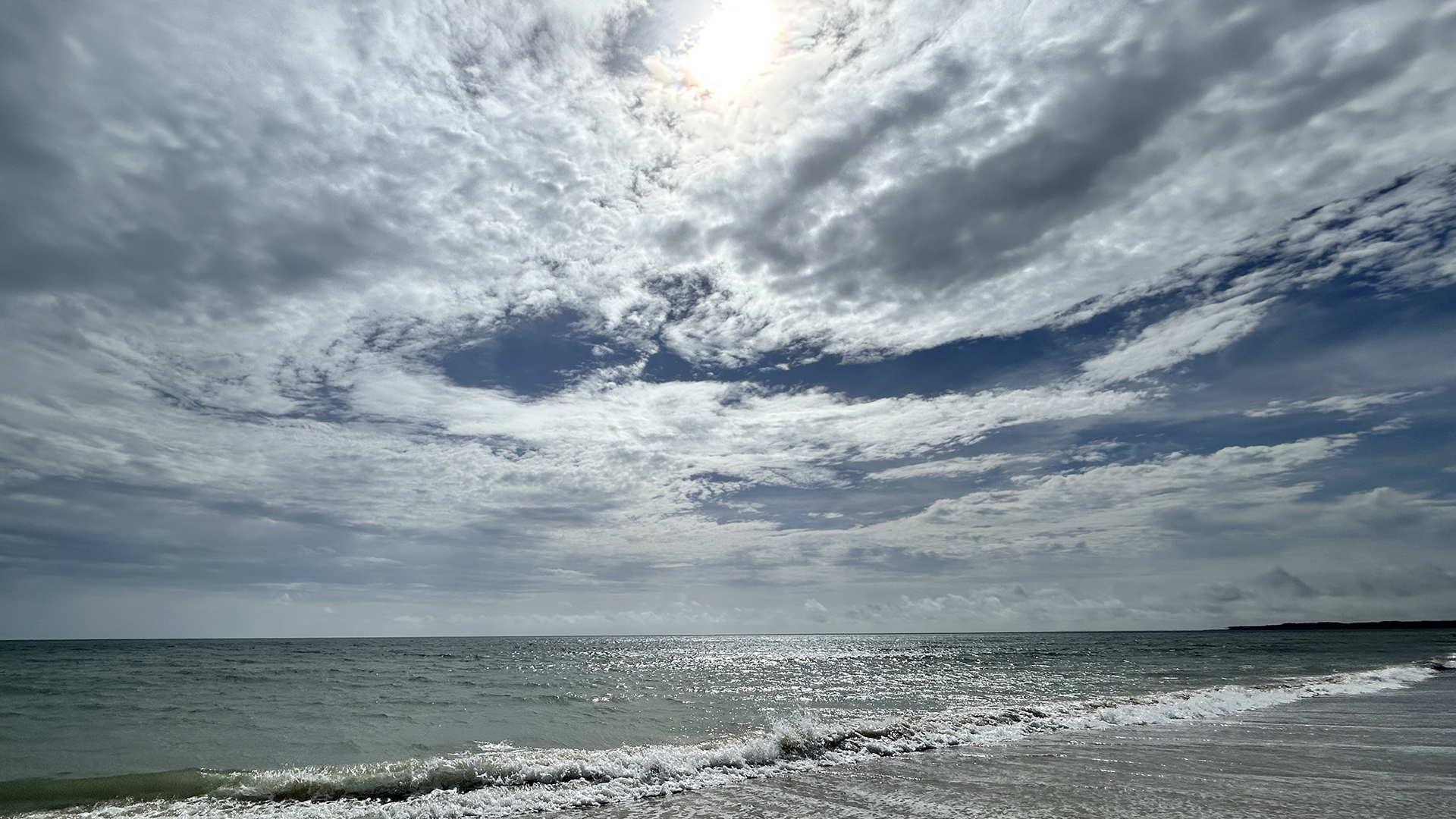
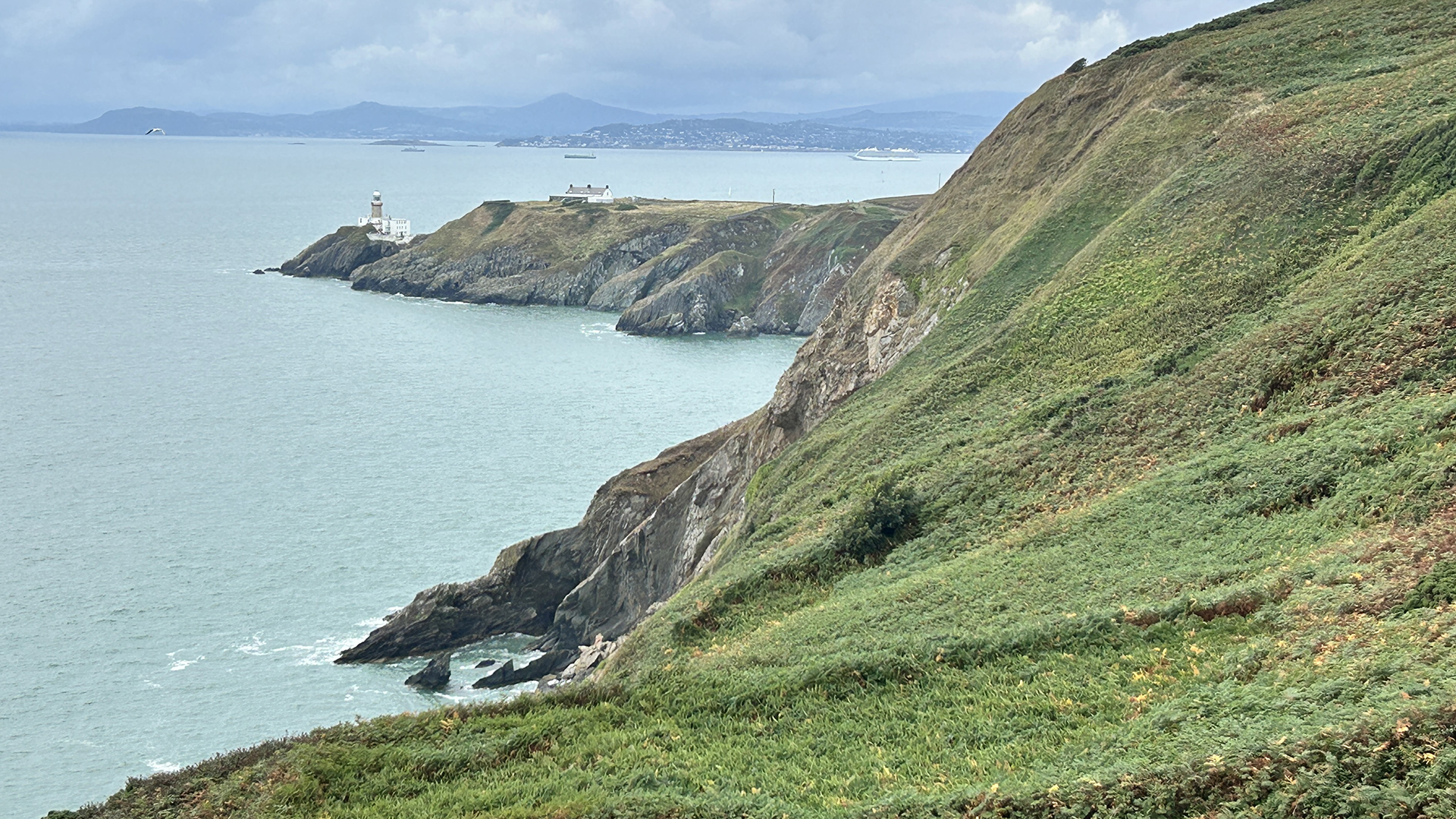
My family left Ireland during the famine. That is the whole story as I have carried it, and it took me a while to notice how little it says. I have spent the last few months researching records, names and dates and towns, and I could see the people in it well enough as facts, a birth here, a town there, a year they showed up somewhere new. What I could not do was picture anyone experiencing anything. That is what I brought to Ballinesker Beach on my last hike in Ireland, a late-morning walk in sand and forest on the County Wexford coast, with the tide out and nothing to climb. Three hikes on this trip, three different corners of the country, and this was the one where the ground under me had something to do with me.
Ballinesker Beach
The day started at Curracloe, with a coffee outside a beach shack flying flags from half the world and locals debating the weather for the day. North was Ballinesker, where they filmed the Omaha Beach landing for the movie Saving Private Ryan. A small sign marks it and almost nothing else does. Inland was Raven Wood, a forest planted on an old sand spit, every pine covered in ivy and loud with birds I rarely saw. Between them, 9.7 miles and 387 feet of gain, which is about as flat as a day gets. Most of my hikes are built around getting to the top. This one didn’t have one, and I was curious what the day would do with that.
What it gave me was time to think about two people I could name but never really see for who they were. John and Bridget, a couple from Rosslea, Ireland who boarded a ship in 1846 with a four-year-old, a two-year-old, and no way back. Leaving is the part I had recorded as one of the things that happened to them. It took a flat beach and a slow morning to start asking what they actually faced, and what the ninety-eight years between their crossing and my grandfather’s would have looked like to the people living through them.
The Journey…
There was nothing to climb, and that took some getting used to. I got to Curracloe around eleven and started the day with a coffee outside the Coffee Break, a beach shack flying flags from half the world, listening to locals debate the day’s weather the way people do when they have known a sky their whole lives. By half past, I was walking the soft sand between the dunes, the beach grass high enough on both sides to close off everything but the light ahead. Then it opened and there was the water. I turned north toward Ballinesker, where they filmed the Omaha Beach landing in the movie Saving Private Ryan. A small sign marks it, easy to walk past. I thought about what the filming must have been like on a stretch this quiet, and then about my own grandfather, who was killed on a beach on the other side of the world in that same war.
I turned around north of Ballinesker and walked back the way I had come, past Curracloe again, until the access to Raven Wood took me inland through tall grass and into the trees. The sea went quiet almost as soon as I was inside. What I found in there was a forest covered in ivy, climbing every pine as far up as I could see, green the whole length of the trunks. The path was wider than a path, more of a road, running straight ahead of me with ferns shoulder high along one side, sometimes both. And the birds. I rarely saw one, and there must have been hundreds, the sound coming from every direction at once.
The loop swung out to where the marsh opened, a channel of still water with a sandbar sitting in the middle of it, the dunes low on the far side, and clusters of small pale purple flowers along the bank. I came back through a gap in the dune on a set of black plank steps with sand pouring over every one of them. The tide was as low as it gets by then and the beach was much wider than when I left it. Firm sand the whole way north to Curracloe, which after eight miles is a gift. I finished at the same table where I started. Over a year of hiking toward summits, and it turned out that a day with nothing to climb suited me just fine.
Gratitude…
The drive to the coast took just over thirty minutes. I went late in the morning to line up with a low tide that would not arrive until much later, not a typical time for me to begin a hike. This was my last one before I fly home, a beach walk at Ballinesker with Raven Wood at the end of it. I kept my eyes on the left side of the road, but there was room for gratitude, and it had everything to do with this trip. My family left Ireland during the famine. That is usually how the story gets told, as though those few words explain something. They don’t. It sounds like travel plans. Not real people making a real decision, one that was forever. Somewhere on the road out I realized I had never once pictured the two of them at a table, trying to decide what came next.
His name was John Peter Bagan and hers was Bridget Tierney. Rosslea, up on the Fermanagh border, a long way north of this beach. He was forty-one and she was thirty-four, married seven years, with two boys. Joseph was four. Patrick was two. In the autumn of 1845 the potatoes came out of the ground black, and nobody yet knew it would go on for years and take a million people with it. They did not wait to find out. By March of 1846 they were on the far side of the Atlantic, which means the whole thing was settled within a few months of the first bad harvest. I have taken longer than that to make up my mind about things that mattered far less. Two people looked at one ruined autumn and chose to live the rest of their lives somewhere else.
Getting out meant Liverpool first, across the Irish Sea before the real crossing started, with a four-year-old and a two-year-old and whatever they had left. I keep trying to picture the moment before they walked on. Not the voyage. Just the standing there. What could be sold was sold, the boys holding on to whatever they could, likely warm clothing, and in front of them a ship bound for a country neither had seen, described by people who had not seen it either. I fly home in a few days with a seat number and a return ticket. They went with no way back, and no way to know whether they had saved their family or ended it. They never got to see how the story turned out. It turned out. And me, five generations later, standing on their coast in good boots with a plane to catch. They could not see any of it from where they stood. I am grateful they did not need to.
Reflections…
My trail-thought from today is a bit different than normal, in that it really started months ago, not on the trail. I have been researching my family’s records, a list of names, dates, and towns running back to John and Bridget in Rosslea, Ireland. Six generations, and I could read the whole thing in about ten minutes. Most of the entries were three words long. It reminded me of the stats I put at the bottom of every post for my hikes. Distance, elevation, coordinates. Everything I need to understand the trail, but nothing about the day. I have done enough of these to know the numbers don’t really reflect the hike. Somewhere along my beach walk, it occurred to me that maybe I had been treating my family history the same way.
So I started thinking about the story behind the numbers. John and Bridget had landed in New Orleans in March of 1846 with Joseph, four, and Patrick, two. They had left an Irish winter, forty-some degrees and wet. What met them at the dock was a Gulf spring in the low seventies, damp and heavy, nothing either boy had felt before. From there, the family went up the Mississippi by steamboat, weeks on the river with two small children. I do not know how they traveled, and I would guess deck passage, which was probably what their money allowed. That meant riding on the main deck with the freight and the engine, with no bed and no food provided, all while cholera moved through the river traffic. At the end of it was a lead-mining county in northwest Illinois, where they stopped.
Their son John Peter was born there in 1851, one of seven. His son Peter John was born in Minnesota in 1880, one of twelve. Not a typo, and yes, still confusing. He married Mabel in Chinook, Montana, in 1914, and their first children came at Corral Coulee, then Zurich, then Eureka. The record gave those names in a row, like stops on a map. But something else was happening. Drought hit northern Montana in the spring of 1917 and did not let go. Heat over a hundred degrees. Wheat prices collapsed when the First World War ended. Half the farmers in the state lost their land. In 1921, the family crossed into British Columbia. The record called that a move. I had started to think it might have been a family getting out, once again.
Daddy Jack was born at Corral Coulee in 1916, one of eleven. By 1940, they had reached Marysville, and he was working at the pulp and paper mill in Everett. He enlisted in 1942 and trained as a Navy corpsman. He was five foot four and a half, a hundred and thirty-eight pounds, with a wife and three small children, the youngest just over a year old, my father. There had already been two ships in this family’s story, the one out of Liverpool and the steamboat up the river. His was the third. In May of 1944, there was no room for him aboard, so he slept in the landing craft carried on deck. At four in the morning, in rough weather, the cable broke and it went over the side with the men still in it. He was pulled from the ocean at half past seven.
One month later, he went ashore at Saipan and was killed at about eleven that first morning. He was twenty-seven. The letter reached his parents in Marysville in 1949, five years later, and said he had died as a direct result of wounds received in action with an enemy of the United States. Then it asked them to acknowledge receipt of the Purple Heart on the enclosed form. Every word of that was true, and none of it was his story. His story was that he was a corpsman, the man who ran toward whoever was hit. He wrote poems, one of them printed in the paper back home, and he wrote one for his own father the month before he died. I have started reading numbers about people more slowly. This trip has taught me that. On that beach, I realized every town name was somebody’s whole year, and every date was a morning somebody had to get through. The path continues.
-Ken
Ballinesker and Curracloe Beach + Raven Wood Nature Reserve, County Wexford, Ireland
Trailhead: 52.383370, -6.3659600
9.73 mi | ~387 ft elevation gain | ~4.5 hours
Morning Walk: 11:30 AM, 67 to 68 degrees, overcast, with sun breaks
My grandfather’s name was John Peter Bagan. The family called him Daddy Jack. I never met him.
He was born in Corral Coulee, Montana in 1916, at the far end of the road his family had been walking since they left Ireland. He enlisted in the Navy in 1942 and trained as a hospital corpsman, which meant that in a landing his job was to run toward whoever had been hit. He was killed on Saipan on 15 June 1944, the first morning of the invasion. He was twenty-seven. He left his wife and three small children, the youngest of them my father.
The medals reached his parents in Marysville in 1949, five years after. The Purple Heart is engraved “John P. Bagan, PhM2c, USNR.”
He was also a poet. Two of his poems survive. He wrote this one for his own father in May 1944, the month before he died
My Dad · May 1944
My dad its proud I am To have a dad like you Your smile so grand your Heart so big Your hand so firm and true.
You’ll always be the pal to me Who helped me as a boy You’ll always be the dad to me Who made my trials a joy
May God always look down on you And smile on you and say Hes the man who’s always true And for me hes O.K. The best of luck old pal of mine And when the sun breaks thru You’ll find your son right by your side In everything you do
Your loving son Jack
And this one for his mother, reprinted in a local paper for Mother’s Day after his death
My Mother
Dear Mother mine I love you And miss your dear, sweet smile; I love the way our say things too, Your patience all the while, God bless you Mom and keep you For this, today I pray, That God will always smile on you For your son while he’s away Keep smiling Mom, and happy, Id keeps you young and gay— I’ll be back to help you out Some day not far away.
Love, Your son Jack.
For most of my life his name went unspoken. This is a small way of speaking it. He was a writer and a healer who went to war to take care of people and gave his life doing it. He was ours, and he is remembered.